
Upton County Court Records After Jail Arrest
After a Upton County jail arrest, the first public record is often the booking record created by the Upton County Sheriff's Office. That record can help identify the person, booking date, arresting agency, charge text, warrant number, and bond field. The court record begins when the prosecutor files a case or a charging paper is accepted by the court. In Upton County, the 112th District Attorney handles felony district prosecution, and the District/County Clerk is the public records office for filed criminal court records.
The booking side and the court side should be checked together, but they answer different questions. The Upton County jail inmate records path is best for current custody, booking dates, and bond shown on the roster. The Upton County jail mugshots path is for booking photos and roster photo limits. Court records after a jail arrest show whether the District Attorney filed charges, whether the charge changed, and whether the case ended in dismissal, deferred adjudication, plea, trial, or conviction.
Upton County Court Records Portal
The Upton District/County Clerk page names LaWanda McMurray as clerk and links the official Tyler public portal for civil and criminal court records. Automated inspection returned HTTP 403, so the portal should be treated as the official browser channel with a clerk fallback, not as a guaranteed automated data source. If the portal blocks access, does not load, or does not show an older file, contact the Upton District/County Clerk at P.O. Box 465, 205 East 10th Street, Rankin, TX 79778, phone 432-693-2861, fax 432-693-2129, or lmcmurray@co.upton.tx.us.
The clerk page is the strongest starting point because it is the county office that points to the public case portal. The portal and clerk should be used for filed criminal court records, not for live jail population checks. If a person was just booked, a court case may not appear until the charge is filed, indexed, and made public. Name spelling from the jail roster can help avoid false no-results in the court search.
| Portal Field | Type | Required | Use in Upton County |
|---|---|---|---|
| Name search | Likely text | Unspecified | Search the defendant name from the jail booking record; exact labels were not captured because automated access returned HTTP 403. |
| Case number search | Likely text | Unspecified | Use a cause, case, or citation number from paperwork when known. |
| Case type | Likely filter | Unspecified | Look for criminal filters in the Tyler browser portal if the interface offers them. |
| Date range | Likely date fields | Unspecified | Use filing or hearing date limits when a common name returns too many matches. |
The official clerk page shows the portal link and clerk contacts used for fallback service.
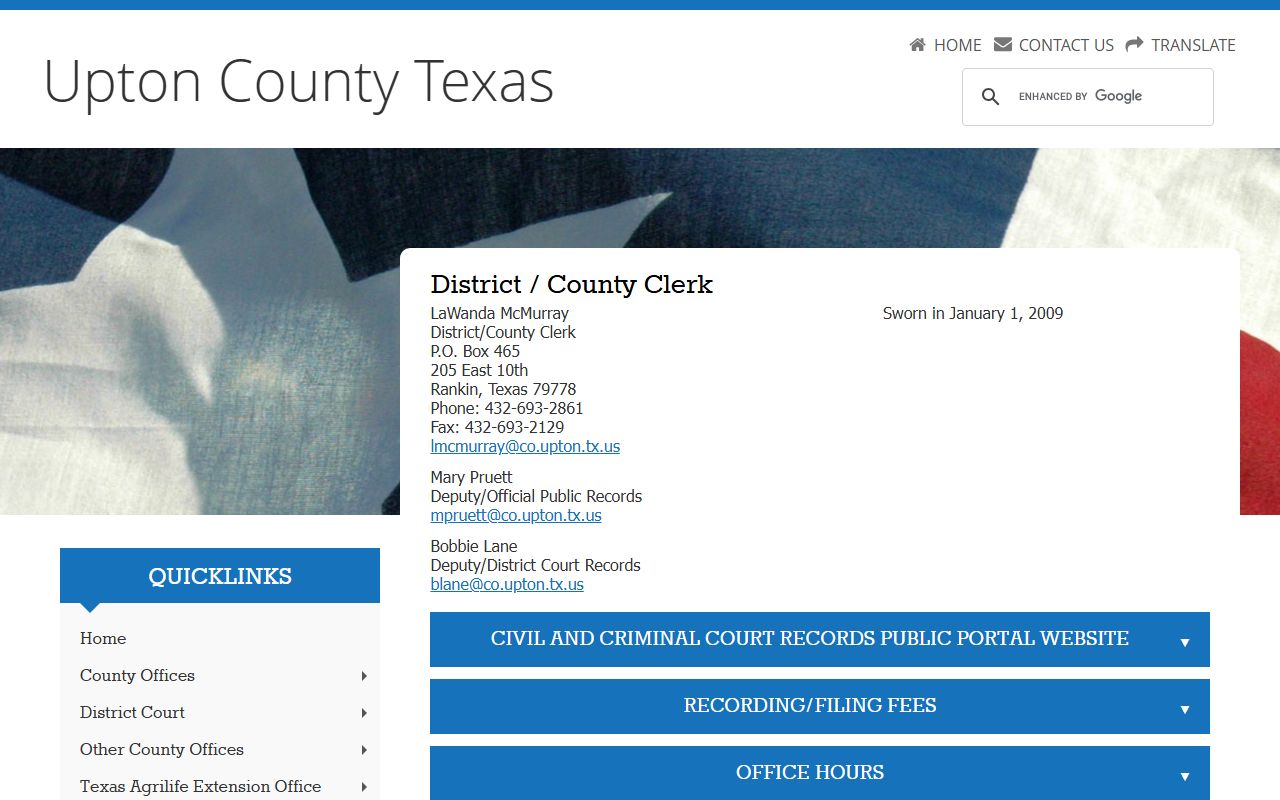
The screenshot confirms that the county clerk page is the local route into court records after a jail arrest.
Find Court Records After Arrest
A practical Upton County court records after arrest search starts with the jail record, then moves to the Tyler portal or the clerk. This order matters because the booking entry may appear before the formal court case. It also helps separate the booking charge from the filed charge. A roster charge may be changed, reduced, dismissed, or replaced by the prosecutor after report review.
- Search the Upton County Kologik roster first for the exact name, booking date, arresting agency, listed charge, warrant number, and bond field.
- Open the Tyler portal linked from the clerk page and search by defendant name. Use the case number if paperwork provides one.
- Filter for criminal case records when the portal offers a case-type option. Check filing date, charge text, status, settings, and docket entries.
- If the portal fails or a record seems missing, call the District/County Clerk at 432-693-2861 and ask whether the case has been filed or is restricted.
Texas statewide sources can help after a case ends, but they do not replace the local court file. The Texas DPS Criminal History Conviction Name Search is a statewide conviction channel, while Upton court records are the local case documents and docket entries. A no-result in the DPS conviction search does not prove that no arrest, pending charge, dismissed case, or deferred outcome exists.
Upton County Charging Records
After an arrest, the District Attorney evaluates law-enforcement reports and decides what charge to file or present. Upton County felony district matters route through the 112th District Attorney, Stephen Dodd. The official DA page lists an Ozona mailing office at P.O. Box 1187, phone 325-392-2025, and a Fort Stockton office at 400 South Nelson, phone 432-336-6294, fax 432-336-3839, and 112da@112da.org. The prosecutor's decision is why court records after a jail arrest can differ from the initial jail roster.
| Charging Document | Who Uses It | What It Means |
|---|---|---|
| Complaint | Officer or prosecutor | A sworn allegation or charging paper used to start some criminal matters after arrest. |
| Information | Prosecutor | A prosecutor-filed charging instrument often used for misdemeanors and some felony paths when legally available. |
| Indictment | Grand jury | A felony charging instrument returned by a grand jury after the case is presented. |
The 112th District Attorney page identifies the prosecutor office that reviews law-enforcement reports after a Upton County arrest.
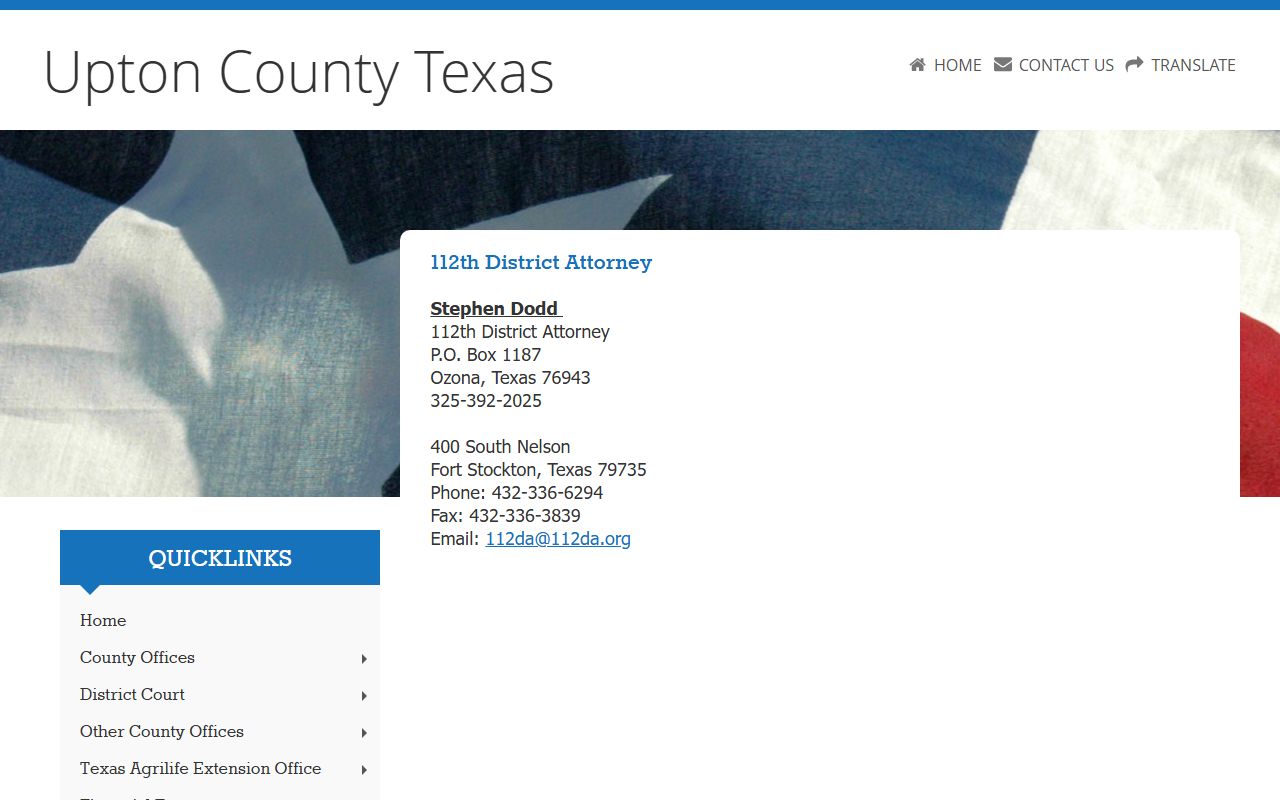
That office context is important because a court case is built from the charge the prosecutor files, not just the charge first typed into the jail roster.
Upton County Court Schedule
The 112th District Court page names Judge Pedro Gomez Jr. and states that Upton County court is held the first Tuesday of each month at 10 a.m. at the courthouse, 205 East 10th Street, Rankin. That schedule matters for felony settings, but not every post-arrest event is a final case hearing. Initial warnings, bond decisions, lower-court matters, or Justice of the Peace issues may occur outside that district court setting depending on the charge and stage.
For court records after a jail arrest, use the court schedule as a timing clue, not as a substitute for the docket. A person may have a first appearance, a bond setting, a later filed district case, and a future hearing date. The clerk record is the place to confirm the case number, charge status, and next setting. The court office and the clerk cannot provide defense advice.
Upton County Charge Status
Charge status is the part of court records after a jail arrest that changes most often. A charge may be pending on the docket, amended by later filing, reduced as part of a plea, dismissed, or resolved by conviction. Deferred adjudication is also a Texas outcome that is not the same as a final conviction unless adjudication later occurs. Always read each count separately because a person can have more than one charge with different outcomes.
| Status | Meaning in the Court Record | Roster Difference |
|---|---|---|
| Pending | The filed charge is open and has not reached final disposition. | The jail roster may still show only the booking charge. |
| Amended | The prosecutor or court filing changed the original filed charge. | The old roster wording may no longer match the case. |
| Reduced | The charge was replaced by a lesser offense or lower level. | Bond and case strategy may change after reduction. |
| Dismissed | The charge ended without a conviction on that count. | A booking record may still exist unless restricted or expunged. |
| Convicted | Guilt was entered by plea or verdict and judgment was recorded. | Custody lookup may move from the county jail to TDCJ after sentencing. |
| Deferred adjudication | Supervision was ordered without the same final-conviction status unless later adjudicated. | Public interpretation can be tricky, so read the judgment and clerk entries. |
Bond and Warrant Records
Bond after an arrest is governed by Texas Code of Criminal Procedure Chapter 17, while warrant arrest procedure is tied to Chapter 15. Upton County does not publish a local online bond desk page, bond payment portal, active warrant list, or bond schedule. The Kologik roster can show bond per charge and a Warrant # column, but current release eligibility should be confirmed with the Upton County Sheriff's Office/Jail at 432-693-2422 before any payment or travel.
| Record Item | Where It May Appear | Upton County Caution |
|---|---|---|
| Cash bond | Roster bond field or court order | Confirm accepted payment methods with the jail. |
| Surety bond | Roster bond field or magistrate order | A bondsman may still need to verify holds and total bond. |
| Personal bond | Court or magistrate record | Conditions may not be clear from a roster card. |
| No bond | Roster charge table or court order | Can reflect a hold, warrant, parole matter, or judicial order. |
| Bench warrant or capias | Court case record | Ask the clerk or court about case-specific warrants. |
Note: A warrant number on the jail roster is not a countywide warrant search.
Charges Versus Convictions
An arrest charge is an accusation, not a conviction. Court records after a jail arrest should be read with that line in mind. A charge can be filed and later dismissed. It can be amended. It can be resolved by deferred adjudication, plea, trial, acquittal, or conviction. The Texas DPS conviction search is useful only for conviction-history questions, while the Upton court file is the source for pending and case-level details.
| Point of Comparison | Charge | Conviction |
|---|---|---|
| Stage | Alleged offense after arrest or filing. | Final finding by plea, verdict, or judgment. |
| Proof level | Can begin with probable cause or filed allegation. | Requires guilt under criminal court standards. |
| Where to verify | Jail roster, complaint, information, indictment, docket. | Judgment, sentence, DPS conviction channel, or court record. |
| Custody effect | May affect bond while the case is pending. | May lead to county jail sentence, TDCJ transfer, probation, or other outcome. |
Sealed and Expunged Arrest Records
Texas Code of Criminal Procedure Chapter 55 is the key expunction law for eligible arrest records. An expunction is different from a routine dismissal entry or an informal request to remove an online item. Juvenile records, sealed matters, active investigations, privacy laws, and court orders can also limit public access. If a Upton County court record is sealed or expunged, the public portal may not show what an older booking or search result once suggested.
| Point of Comparison | Sealed | Expunged |
|---|---|---|
| Public access | Hidden or restricted from ordinary public view. | Removed under a court order where legally granted. |
| Agency access | Limited access may remain for certain justice purposes. | Access is sharply limited by the expunction order and law. |
| Typical trigger | Specific court order or statutory confidentiality rule. | Eligibility under Texas expunction law after qualifying outcomes. |
| Where to check | Clerk office, court order, attorney review. | Clerk office and the expunction order itself. |
Restricted Upton Court Records
Not every court record after an arrest is fully public. Texas public-information law starts with access, but it also includes exceptions and confidentiality rules. Juvenile justice records are treated differently from adult records. Active law-enforcement material, sealed files, expunction orders, certain personal data, and some court exhibits may be withheld or available only at the clerk counter. For court documents, ask the clerk. For sheriff booking records, ask the sheriff or jail. For TCJS oversight material, use TCJS open-records channels.
Important: Upton County Inmate Population is not a consumer reporting agency, and records may not be used for FCRA-covered decisions.